
Generative artificial intelligence is becoming a permanent part of advertising, contributing to commercials, characters, images, animation and new shopping experiences.
Brands, agencies and studios are combining image, video and text generation tools to produce campaigns faster, test concepts and develop narratives that would be difficult or expensive through traditional production.
A selection published by Ad Age and covered by Meio & Mensagem gathered five recent initiatives involving World Cup content, Fi Ultra, Amazon, Papa Johns, Meta and Chiquita.
1. World Cup stars become anime characters
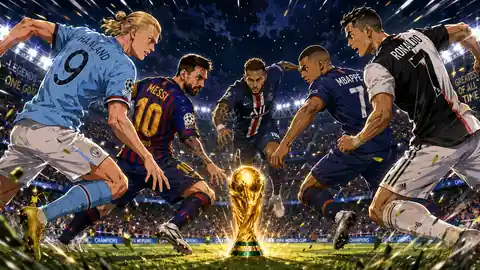
Creators are using generative tools to transform players such as Lionel Messi, Erling Haaland and Kylian Mbappé into Japanese animation characters.
Sporting clashes are reimagined as comic-book battles with dramatic effects, cinematic framing and special powers.
Higgsfield AI and creator Steven Wommack helped expand the trend by sharing a tutorial on the process.
2. Fi Ultra produces an entire commercial with AI
Fi Ultra launched a 60-second commercial produced entirely with artificial intelligence.
“Unleash the Wild” uses mountains, roads, vehicles, animals and natural landscapes to demonstrate satellite tracking.
AI studio Dolsten & Co. combined Claude, Kling AI and Google Veo, using real team members’ dogs as references for photorealistic digital versions.
The production also recreated handheld movement, dirty-lens texture and the irregular motion associated with real footage.
3. Amazon and Papa Johns turn an ad into a point of sale
Amazon introduced Alexa+ Agentic Ads to bring product discovery closer to purchase.
In a demonstration, consumers interact with a Papa Johns ad on an Alexa device and order a pizza without leaving the experience.
The project connects artificial intelligence, advertising, devices and e-commerce in a single interface.
View Amazon’s official demonstration ↗4. Meta introduces Muse Image and prepares a video model
Meta unveiled Muse Image, an AI model designed for image generation, and also announced Muse Spark and work on a video-generation model.
For advertisers, models such as Muse may support concept visualization, product imagery, campaign variations and pre-production testing.
Explore Meta’s Muse models ↗5. Chiquita revisits United States history with AI
Chiquita used artificial intelligence for a campaign related to the 250th anniversary of United States independence.
The commercial places the brand across the Old West, the Golden Gate Bridge, Times Square and Woodstock, with Miss Chiquita appearing in historical scenes.
The production by Silverside and Mediaplus embraces a visible generative-AI aesthetic.
AI expands the possibilities of advertising creation
The initiatives show AI operating across character creation, film production, imagery, consumer interaction and commerce.
Human professionals remain responsible for concepts, scripts, creative direction, tool selection and curation.
AI expands the paths available to creative teams rather than eliminating the need for strategy and craft.
Creative direction remains decisive
Accessible generation tools make creative direction even more important.
Technically impressive images still need to reflect brand positioning, audience behavior, cultural context and commercial goals.
The strongest campaigns use technology for a clear strategic reason and integrate it naturally into the creative process.